By Carolyn Edlund
What do art consultants do? Should you work with them? Would you like to be an art consultant?
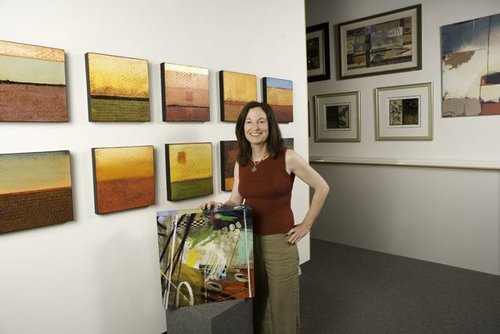
Art consultant Barbara Markoff
Artsy Shark went right to the source to find out the answers. Barbara Markoff of Becoming a Corporate Art Consultant literally wrote the book on this topic. She has some expert opinions that will help you find opportunities in this market if it is appropriate for you.
AS: How do art consultants get started in the business? What is a typical background?
BM: Corporate art consultants generally have some art background. That may be owning an art gallery, art and framing company, or working for an art publishing business.
A strong desire to be involved in the arts seems to be a common thread as well. Art consultants bring to the table a range of skills. These include a keen sense of how to match artwork to specific businesses and how to effectively communicate to clients how artwork will enhance their work environments.
For most corporate art consultants, their business expands into the corporate market gradually. Art gallery owners get requests from walk-in clients seeking artwork for business settings. Some interior designers provide corporate art consultation as a service. This is natural, since they are already selling furniture, lighting, flooring, and accessories.
The typical art consultant has studied art or art history in college and chosen a career in the arts. Some start out as picture framing designers. Others may actually be artists who enjoy the challenge of selling artwork.

AS: What do art consultants want from artists? How can artists plan their work, either in subject matter or materials, for the corporate setting?
BM: Art consultants make their living selling artwork, and we are always looking for new talent. Adding new artists is important because each art program we sell needs to be unique and fresh, not a repeat of what we did for another client.
The relationship between the art consultant and the artist is one based on mutual respect with the goal of placing artwork in the corporate setting. Feedback from meetings with decision makers is helpful in directing artists to create appropriate artwork in terms of color, subject matter, and scale, while remaining sensitive to budgets.
Artists who are interested in forming business relationships with art consultants need to be professional and have a good body of work available, an updated biography and artist statement, and a viable website. Visiting newly furnished medical facilities, banks, office buildings, or other corporate environments is an educational experience. It is a fantastic way to understand corporate art solutions. Unless an artist is familiar with what is selling to the corporate market, it is hard to know what type of artwork to produce.
Art consultants are looking to form relationships with artists that are professional and who present themselves as business people. I have devoted an entire chapter in my book, Becoming A Corporate Art Consultant, The Handbook For Corporate Art Consultation, to working with artists. I discuss other ways for art consultants and artists to find each other and how they effectively work together.

AS: What would your “perfect” artist partner be like?
BM: For me, the perfect artist partner is an artist that does not mind taking art direction for my projects. Often the art decisions are based on color and size. Knowing that my artist partner will happily create work for me based on my recommendations makes my job much easier.
Turnaround times are often quick, and my ideal artist would be willing to create artwork quickly and allow me to show it without purchasing until the client knows it is exactly right for the project. Since art presentations are critical to the process of developing an art program, my ideal artist partner allows me to keep a portfolio of pieces that I can regularly show as appointments come up.
Sometimes I get very little notice when asking to show artwork for a corporate project. Having the artwork on consignment really helps when these short deadlines occur.
AS: How do art consultants meet artists?
BM: There are many ways that art consultants can meet artists. One excellent way is to join art related groups on the social networking site LinkedIn. Artists and art consultants join these groups and many artists list their websites on their profile page. I have found several wonderful artists through LinkedIn. Some of the Linkedin groups I would recommend to partner artists and art consultants are, Creative Art Consultants, Contemporary Art Network Group, and Professional Fine Art Network.
Other common ways for art consultants to find artists are by visiting local and national art fairs and exhibitions, exchanging information with art gallery owners in other part of the country, and by posting a notice on their website that they are looking for artists.

AS: What percentage of the art you install in corporate and residential settings is framed? Sculptural? Other?
BM: Trends in artwork change and evolve like fashion and interior design styles. In the 1990’s a typical corporate art program consisted of framed photographs, canvasses, and posters. With the recent advent of digital printing, the whole scope of art offerings has expanded, and it is very exciting.
Today art programs are far more interesting, consisting of three-dimensional works and digital printing on substrates such as acrylic, bamboo, tile, and fabric. In the healthcare sector, decision makers are purchasing far more dimensional works such as clay wall sculptures, fiber art, metal and wood sculptures, and hanging mobiles. Canvas wrapped giclees are commonplace too and often an entire art program will consist of these types of pieces in various sizes requiring no framing.
I have definitely seen a shift from all framed pieces to a blend of framed pieces and three-dimensional wall pieces. Currently, I would say that I sell 75% framed pieces and 25% of pieces not needing framing. Of course it depends on the client I am servicing.
Healthcare clients definitely want more dimensional work while law firms and commercial real estate businesses are still purchasing framed work. Overall there is more opportunity for artists to create dimensional work. The good news is that corporate decision makes are very open to seeing all kinds of artwork and they understand the significance artwork plays in the overall design of the facility.


I highly recommend that all artists read Barbara’s book. It is very informative and really helps artists to understand and prepare for the relationship they will establish with an art consultant.
For those that are interested in being an art consultant, there is no other book on the market that is as well written, insightful, or as full of general information that will help you to get your own art consultation business up and running.
Jean, it was your recommendation of Barbara’s book that led me to her. Thanks for the referral, my friend!
What percentage of the overall hospitality project does an art consultant try to make? How do you price photography and art for multiples. As a guide, what percentage does the artist receive from each reproduced print?
very informative article. I will get conected!
Thanks, Kevan. I checked out your website, your fiber art is amazing!
Great interview Barbara. I am a corp art consultant as well and have been doing a lot of work with artists to create giclees on canvas and other substrates (wall paper, plex, etc) of high res scans of their original art. These are typically hand signed by the artist and sometimes hand embellished. The artist retains the original and copyright, gets paid a royalty + cost of scanning, and we pay all printing, stretching and installation. The process has been great for artist as we teach them the process. Once the art scan has gone through pre press it is ready to roll again. So I would recommend to artists that they be open to this concept. You can create a line of art for reproduction and a seperate line for gallery only work.
Studio Art Direct,
Please contact me. I would love to explore your process in my work. Carolyn interviewed me earlier this year on her site. She has nice talent presented from all arenas in the art world.
Please review my work at http//kellyannrt.com
I have been producing limited editions & working with an east coast fine art printer.
Best, kellyannart.com
I should clarify, we are not publishers. We create custom reproductions depending on client needs. So I should not have used the word “royalty” as we don’t own the copyright.
Extremely informative!
This is an area which I have been considering, and this article has certainly pushed me in the right direction.
My photographs are usually printed large and enclosed in acrylic float frames, but I am open to change if the change doesn’t destroy the integrity of the work.
Hmmmmmmm, new ideas are already forming…I love interviews and articles that can do that!
Sandy – I’m really glad to see artists putting this information into action. Art Consultants have a whole industry which can be taken advantage of – keep thinking of new ways to sell your work!
Agreed! As a Corporate Art Consultant it is extremely important that the artists I work with are professional business-minded individuals. They must understand the corporate art commissioning process and be willing to work to the client’s ideals in an acceptable time-frame.
Thanks, everyone, for your comments – I know artists would like to be more informed about this type of opportunity, and would like to encourage conversation with my readers. Please visit the corporate art consultant sites of commenters by clicking their links!
Carolyn,
I have been placing my work in corporate lobbies, hospitals & most recently hotel foyers.
I have worked with curators & agents. I must admit, I enjoy my most recent experience as I study the market around public art. My current agent obtains a fee from her 6-8 corporate lobbies bi monthly. The artist obtains 100% commission of projected sales.
Of course, the artist in this situation is not commissioned, yet chosen for exhibiting their current and/or annual collections for exhibition.
I desire to create continued opportunities to showcase my annual collections in the public eye.
I appreciate your information & hope to connect with other consultant professional. Best, kellyannart.com
Thanks Kellyann. You are one artist who is very active in marketing and exploring new opportunities. As you know, it’s what leads to success!
Carolyn,
You are too kind & I wish you the same, as you explore all sides of art. If I can recommend what you do in any way, let me know.
I would like to connect with your art consultants & have sent them an introduction, so planting seeds.
Best, Kellyann
Lots of comments.
I have my artwork on a site that creates and rents digital prints of my art plus acts as an agent to sell the originals. The digital prints are sent on a rolling basis much like Netflix does w/DVDs.
I also have the Artist Marketing Resources blog and receive about one thousand visitors to my blog per week–if anyone would like to promote their services on my blog( I have hundreds of subscribers too). Email me at: [email protected]
Is it OK for me to say that, Carolyn?
Absolutely, Marie! You have a really great and useful blog and LinkedIn group as well (check out Artist Marketing Resources under “Groups”). Marie was a featured artist back in February. You can see her portfolio at http://bit.ly/bcAqvl
Thank you for this extremely informative article. I also have been looking to enter into the business opportunities of creating corporate artwork. I will look forward to reading more in the book. Having worked as an art director and illustrator in the past, I can completely understand the art consultants point of view on needing timely work done by business oriented artists.
My work is quite varied from contemporary to traditional and fairly large to mid sized pieces. My question what are the current trends? I see primarily abstract pieces shown. I would like to connect with art consultants who feel my work might fit their needs. I am used to accommodating short deadlines after a career in advertising.
I have had a wonderful relationship with an Art Consultant here in Sacramento for years. Most of the projects are commission pieces like metal corporate logos for lobbies, large metal wall art pieces for hospitals, and interior sculptures.
Working with an art consultant is a great source of income for me and it gets my work placed in buildings and exposure that I would never have otherwise.
The Art Consultant works with interior designers to conceptualize an idea and then we work together to tweak and flesh out the design. I still get to add my artistic value to the project and everybody wins.
Here is a sample of some of the pieces I have created
http://www.kristenhoard.com/portfolio/commissions
I am so pleased to have found your site. This morning I received my first contract from an art consultant and you have given a great deal of information on how to proceed to make the best relationship. I will also check out Barbara Markoff’s book. Thank-you!
Terrific, Ruth – best of luck with your foray in this market!
I have been painting for a number of decades. A few years back, I became able to do this full time and have produced a representative body of work. I now want to start selling this stuff. I am unfamiliar with Art Consultants but know some people who have had some positive experience. How does one identify and contact an appropriate art consultant?
Gherry, I would suggest that you check out Barbara’s website or book, or perhaps find a group on LinkedIn for art consultants. I’m sure some of them hang out there!
Thank you for this article Barbara, I am feeling a little directionless for a long while and this is just the boost I need, thank you again, best wishes.
Isn’t it ironic that we as poor artists have to BUY a book for information on how NOT to be a poor artist?
Sassafrass, Every occupation has best practices, and ways to succeed. If you are thinking as a “poor artist” you seem to have a negative attitude, that actually might improve if you improved your business skills.
I agree with this mentality. As long as you find the right buyer, your art will be worth more than the starving artist who sells on the street.
Thank you so much for the article. This is very useful especially for someone with no experience of selling art. My father just held another art exhibition in the architectural company, where he works. In his portfolio he has sketches, watercolors, mixed art, visual installations and photographs. We are looking to take the next step and explore selling opportunities. My dad built his website where he shows samples of his portfolio (LeonidKravchenko.com). I was wondering if you can recommend any art consultants in the NYC area? What would be a good step to take? Thank you.
Roman, to find an art consultant in any city, you can do an online search to locate them. Then, do your research – what do they specialize in? Is it a match for your father’s art? If not, don’t waste your time or theirs by approaching the agency.
Take another look at the article above and start networking, in LinkedIn groups, and through organizations. It takes a lot of work to identify those consultants who would fit well with what you are selling.
I’m a writer working with an artist who wants to approach art consultants. Is there a common approach among consultants when determining a price for work?
Beth, your artist client needs to know their price going in, and they should be confident and consistent with this. See this article https://www.artsyshark.com/2011/05/06/pricing-your-artwork/. The consultant does not determine the price – they are effectively acting like a gallery because they will take a portion of the selling price. You may work with them to find something in their budget, but the artist themselves must know that their share of the price is profitable for them.
Sometimes a consultant will offer a “single-use” license for certain projects, and that is another type of purchase. Other times, the artist will do commission work. Commissions will often be priced higher than outright sale because of the extra work involved.