A Site for Emerging Artists
Posts tagged Education
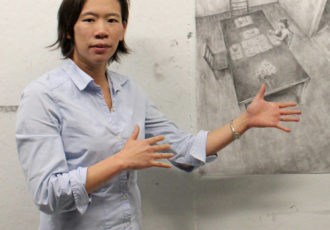
The Critique
Jun 15th
By Carolyn Edlund
You hated them – the dreaded critiques. Showing up for class and waiting your turn to be rated and criticized and hopefully praised in front of others.
They could be brutal. I remember a drawing teacher asking for volunteers to present their work. One student stood up and proudly displayed his still life, at which point the teacher approached him and grabbed the drawing. Ripping it in half, he declared it garbage.
They could be useless. A painting instructor once asked each student in turn to present their portfolios, give a critique of their own work, and declare what grade they should get. The instructor had no input.
We secretly crave critiques, though. We know that to improve, we need the opinion and input from someone we respect, an authority with the ability to help us reset our compass and find our true north. Have we strayed too far into the trite, the derivative, the boring? Tell us the truth.
We don’t want our mothers to tell us how talented we are. We want Simon Cowell. Someone starkly honest, even if it hurts. Someone to give us an appraisal and tell us like it is. Who doesn’t know us and can see our work objectively, as the market will see it. That’s where our growth can take place.
We also need to have the ability to take from that critique what really works for us and not be crushed or derailed if we don’t get good news. Maturing as an artist means that we have a sense of ourselves, and a confidence in our work. Our inner guide determines our direction. The critique acts as a check and possible course correction, especially valuable if we are unsatisfied and know that we need feedback to adjust.
Has a particular critique been a defining moment for your work? Was it positive or negative?
Turning Artists into Businesspeople/Interview with MICA Dean David Gracyalny

Jan 10th
by Carolyn Edlund
Are you an artist with the desire to make a career in your field, but feel that you don’t have the business knowledge to be successfully self-employed? This is a common problem, which has been exacerbated by a general lack of business education at the undergraduate level in many art schools and university art programs.
I had the opportunity to speak with the Dean of Continuing Studies at Maryland Institute College of Art (MICA) , David Gracyalny, about this need, and a new graduate degree that the school is offering to educate and prepare artists for the challenging business world.
The past few decades have been a time of immense change in the way artists do business. Gracyalny speaks about “returning distribution of creative product to the creator,” or giving control of art business and sales to the artists themselves, a trend which started back in the 1970’s and 80’s and is rapidly becoming a new business model.
The Master of Professional Studies (MPS) degree at MICA is a 14-month program, alternating brief “residencies” (which are actually long weekends) where the students meet with faculty and each other, with intensive online courses lasting eight weeks. This degree is described as “small business administration for artists and designers.” Structured to be convenient for students in the work world, it can actually accommodate international attendance.
MICA is an art school with a superb reputation in the United States, and their MPS in the Business of Art and Design program is the first of its
kind in this country. Course selection includes Financial Management, Marketing (including social networking), Art Licensing, Human Resources, Contracts, Taxes, Intellectual Property, and Public Speaking, among other subjects. These are specifically tailored to relate to the creative community rather than general businesspeople.
Gracyalny cites a statistic from the U.S. Department of Commerce regarding the lifespan of small businesses: Sixty percent will fail within the first four years. Eighty-five percent of the surviving businesses are run by people with business training. This makes it essential for artists planning to become self-employed to learn the art of business.
Interested? The application deadline is rapidly approaching. Check out MICA’s website for more information.
Oh, and about those of us who are still disappointed that we didn’t get enough business know-how as undergrads? Thomas James of Escape from Illustration Island has written an “Open Letter to Art Students Everywhere”. I think he makes some excellent points.
Is an Art Residency Right for You?
Dec 2nd
Have you ever considered applying for an Art Residency? This type of opportunity can be a great experience – or not. Guest Blogger Joseph Cavalieri has been working in glass as a fine art form since 1997. Collected and exhibited worldwide, his work can also be seen on TV in The Simpsons 20th Anniversary Special and in two issues of the Corning Museum’s New Glass Review. His MTA Arts in Transit public art commission is located at the Philipse Manor Metro North Station. To see more work visit: www.cavaglass.com.
The Residency Dance
By Joseph Cavalieri
Within the last 2 years I’ve had three residencies in Australia, India and Scotland. Each arrangement was different and resulted in different outcomes. I’d like to share what I have learned artist-to-artist of how to make an art residency work best for you. If done the right way they can be inspiring, productive and a great boost for your career. If the wrong choices are made they make you feel secluded and empty your pockets of cash.
HISTORY
Residencies originated as organizations that supported artists one-hundred percent. They gave room, board, living expenses, and introductions, among other perks. Often the host was a private or non-profit organization, and received grants for supporting art. In return for their “support of the arts”, they improved the local community, added to their collection, and create a long-lasting relationship.
The term “residency” has changed over time. Now each are extremely different and offer varied arrangements. Some you may need to pay for the accommodations, travel and bring your own supplies. Read the fine print before spending the time on the application.
RESEARCH
Before you even start to research residencies you should have answers to very big questions about your work. What you are searching for as an artist, how you define success. These come under what we call a “Vision Statement”. It is the basic reasoning behind why you do your art. If a residency is in your vision statement, list what you want to get out of it before starting your search.
My “vision statement” includes teaching, inspiring other artists, and traveling. These are not first on the list, but they are an important element of my vision of being an artist. You may want a residency to be inspired by new surroundings and people, or a retreat to quietly continue your current work, or even to make contacts for future shows. Be honest and clear with what you want.
Think about if you can survive financially and mentally away from your studio for a month or two. Time spent at a residencies can result in you producing less work. It takes time to adjust and set up a new work space in a new environment. You may need to bring supplies or figure out how to buy them in a foreign country. These are all things you need to consider before applying. Remember, residencies should not be considered vacations. They are hard work, with a high level of socializing thrown in.
THE SEARCH
With the “vision statement” in hand you can now start your search. To save time, I have a list of residency deadlines listed by month, so if I am not accepted this year, I know when to apply next year. Apply about a month in advance, so you are showing recent work, but not working the night before. My top three web sites for searching include residencies are Wooloo, Café, and TransArtists .
A shortcut for searching residencies is to read CV’s of fellow artists in your field. Here you will find residencies they did in the past. You can also contact them for questions and advice.
Once you find a potential residency, search their site for the application form. If this does not exist, send them a short e-mail asking for the “guidelines for submitting an art-in-residency proposal.” No need to tell them about you or your work. Remember most of these organizations are non-profit and the staff has limited time.
IF A RESIDENCY IS NOT OFFERED
If you can’t take a full month off or is an organization does not offer a residency, you have options. A local college may be open to having you stop by as a visiting artist, even if they don’t have a formal residency program. Once you find the correct contact persons, send a clearly written proposal. Include the project, supplies, timing, and how you want to be reimbursed. Be creative – they may be much more open for a two day visit instead of two months.
SUBMISSIONS
Follow all steps as exactly as possible, and write your ideas out as clearly as possible. If this is not done they will trash the application. When asked for images of your work, I prefer to send a couple of close-up shots to show details. Consider how your work is best understood. To show scale and context you can show one photo including a frame or two pieces hung side by side.
I highly recommend incorporating community interaction into your project. Think about the host, having different artists come and go every year. If you have a connection with local people, it keeps a bond between them and the host, which is something the host may be wanting. Be creative with the proposals you are offering them. Write as clearly as possible – remember they are reading huge amounts of applications.
PAPERWORK
Once you are accepted, you need to do research and make as many contacts as possible before you physically arrive, so when you arrive you will have a group of people to work with, socialize with and (most importantly) ask questions of. Ask for any contacts your host has. Do a Google search or find local artist organizations and contact their members. E-mail a “letter of introduction” and simply invite them to meet you during your stay. I offer to share techniques. In turn, these professionals can help you find supplies, make gallery connections, help you get around, and even loan equipment. I never ask this in my initial email, it just naturally comes up after you get to know each other. This is one of the big reasons for a residency – to connect with the locals. Staff can help, especially if you want to meet instructors at a local art university.
Does the staff have contacts at local galleries and museums, or do they have contacts at schools and universities? You may want to do a demonstration or lectures at different organizations during your residency. If you want to do a lecture for, say a local college, try to get your host involved, so the students not only learn about you and your work, but see how this residency works and learns about the hosting organization.
Once you get to know your host well, ask if they have collectors who may be interested in meeting you and seeing your work. Don’t forget the press. Search out newspapers, websites and blogs before you arrive and send a press release on your project asking to have it covered.
BONUS
If you have extra time during your residency, you can propose a permanent instillation. This is a fine way to have your work remembered, seen by future visitors, and is good listing on your CV.
The types of residencies available are varied and numerous, depending on your area of expertise. It takes research and asking the right questions, while organizing your steps carefully. Once you get this done, you can have a stress-free time to create the project you set out to do without complications.
Mom was Right
Nov 28th
By Carolyn Edlund
Many years ago I received some career advice from my mother. This was back in the 60’s (think Mad Men) and she gave her best recommendation for a suitable job. She advised:
“Be a secretary.”
Taking her advice, I enrolled in typing and shorthand classes in high school. Mr. Gatti, the typing teacher, would call out letters and his students would click and clack in unison on manual typewriters in grueling drill sessions, forcing ourselves to learn the keyboard. I studied three years of Gregg shorthand to become proficient, and took other office-related classes in the Secretarial Program.
Why was Mom right? Because although I didn’t have a long stint as a secretary, and ended up with a career in the arts, I took some very important skills with me that I am able to use to this day:
- I can type very fast (and we know that comes in handy).
- I learned how to write an excellent business letter, using proper form and grammar.
- I learned how to speak with people on the phone clearly and professionally.
- I learned how to stay organized, follow up and make a tickler system.
- From the smart attorneys I worked for, I learned some super-effective collection techniques. The results? In over twenty years running a studio, my uncollectible accounts totaled only $200. Yes, that’s right.
- I got a business background from the ground floor that enabled me to develop a mindset geared towards how to be successful.
If I was your Mom, I would make this suggestion to you:
“Be a businessperson.”
Yes, I know that you are an artist. But I also know that you need certain skills that will become an intrinsic part of how you run your career and will dramatically improve your chances of making it all work. I have also found this to be true:
The people I have interviewed who have become the most successful artists are people who had a background in business.
You don’t need to get a degree in Business, become an expert in accounting, or learn Gregg shorthand. But you do need a sound background so that you can do something with your art skills that will turn them into a money-making career. That’s because you are an artist and you are also a businessperson.
Love, Mom.
Do you have a background in something that has given you skills to enhance your art career, even something unusual? Please comment!
Artsy Shark Poll – Ready for an Art Career?
Mar 24th
Please leave a comment. Do you feel you were prepared for a career in art? Did your education emphasize the business of art and how you could be successful? What could educators do better to help art students prepare?
(polls)
Print
Digg
StumbleUpon
del.icio.us
Facebook
Twitter
Google Bookmarks
Reddit
email
FriendFeed
LinkedIn
Tumblr


Featured Artist Leah Jay