A Site for Emerging Artists
Posts tagged portraits
Featured Artist Olga Gouskova
Jan 8th
Artsy Shark is pleased to present the stunning portfolio of artist Olga Gouskova. Please visit her website to see more of her work.
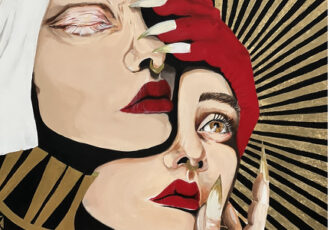
Often walking hand-in-hand with controversy is the sensual female form, Russian born, Belgium-based artist Olga Gouskova certainly knows how to capture an audience with her paintings of beautiful and stylish women.
Gouskova’s women are sexy, melancholic and mysterious, with a powerful physical intensity and a subtleness of form which almost makes you want to caress them. Her female figures do in fact caress themselves, almost as if to emphasize the preciousness of the female body – the eternal-based source of life and love.
The sinuous lines convey vibrations, memories, ambivalent feelings and deep emotion by means of the positions and expressions of the figures. Her paintings are about feelings and states of mood, about dreams and expectations. And she expresses it through the female portrait. In every painting she tries to capture part of the mystery of the female personality by combining the beauty of the physical with the intensity of the mental.
Her contemporary approach to pose, dynamic composition and colour produces paintings that are modern, proud, vibrant and uniquely individual. When painting, Gouskova uses two different techniques. She draws the body with sepia pencil to make it look almost real – warm and soft, giving it a feeling of physical intensity and a subtleness of form, outline and volume. For the rest of each painting she uses acrylic and all kinds of pens to draw lines and small decorative details. She doesn’t paint the volume, using instead flat washes of colour. The lines and patterns make the composition dynamic and complete.

Olga Gouskova was born 28 July 1974 in Moscow, Russia. She grew up in Belarus.
1985-1992 Byelorussian Art lyceum, Minsk, Belarus
1992-1996 Byelorussian Academy of Arts, Design department, Minsk, Belarus
1996 immigrated to Belgium. Since 2002 she lives, loves and works in Bruges.
Featured Artist Mark Powell
Jul 14th
Images of Life/Interview with Steve Paxton
Jun 11th
By Carolyn Edlund
Photographer Steve Paxton has a thriving business taking wedding and portrait photos. He also maintains a separate website for his other photographic pursuits, including a project called “The Least of These”, an Urban Portraits portfolio featuring amazing images of the homeless in Seattle. His website contains stories about his subjects, information and tips about photography and approaching the homeless in conversation, videos and much more.
Take note of how Steve’s professional presentation, commitment to his work and his following establish him as an expert and a great resource for clients, as well as other photographers and artists. He shows a spirit of generosity in sharing his expertise through Q&A and tutorials, featuring the work of other photographers and promoting excellence. Steve is an outstanding model for emerging artists. He agreed to speak about his Urban Portraits portfolio and other projects.
AS: What prompted you to start on your Urban Portraits project? What will you do with it?
SP: The project began in 2007 after I started searching for something different and unique to photograph. I was slowly burning out and needed to approach photography from a different angle. As a portrait photographer, I had always wanted to capture photographs of individuals living on the street. Capturing “urban portraits” started out as something that I thought I would try once or twice just a break from the sometimes routine nature of regular portrait photography. As time went on and as I began making connections with people living on the street, I realized that it was more than just capturing photographs. Each person I met had a different life story and most were eager to share it with me. The stories help to bring my images to life. Now each year I make time to periodically head out to Seattle to reach out to the homeless living on the streets. I occasionally bump into homeless folks that I met a year or two earlier. It’s fascinating to hear about what they have been up to.
AS: On your site, you show your urban portfolio with stories of your subjects. What have you learned about the homeless people you photographed?
SP: I think about this quite a bit as I walk up and down the alleys making contact with the less fortunate. As you might guess, I mostly run into older men living on the street. Occasionally I meet a homeless woman, but they are almost always with a man. The city can be a dangerous place at night so you don’t find many young teens or women running around alone. I found that many of the men I meet on the street are dealing with one or more of the following issues:
(1) Addicted to alcohol and/or drugs
(2) Have a mental health issue, or
(3) Lost their spouse to death or divorce.
The last one really surprised me. Losing a spouse can be terribly difficult for someone. For many men, their wife is what helped keep them stabilized and grounded. It’s really sad to see a man living on the streets openly weep about losing his wife. Stepping back for a moment, imagine if you are dealing with several of these issues at once. It’s a situation that can go from bad to worse very quickly. A middle aged man loses his wife which in turn sends him into depression. This causes him to drink which leads to him missing work. This causes him to lose his job and eventually his house. One thing leads to another and he quickly finds himself living on the street or out of his car. The most striking thing about this is that it could happen to any one of us.
AS: The quality of your photographs are amazing. Are you using any special techniques to achieve the look?
SP: I use various techniques in Photoshop to create the distinctive “look” in each of my urban portraits. I prefer muted, dark, edgy urban images. I choose to apply this type of processing because I believe it suits the subject matter very well. I also like the style.
Going decades back, street photography was traditionally shot with high contrast black and white film. This creates the dark, urban feel that most of us expect to see in street photography. I have chosen to vary this just a bit by allowing some of color to show through while still maintaining a high contrast, desaturated feel common in urban scenes. Not everyone is going to like the look and feel of my images, but I am OK with that.
AS: Please tell us about your other work and how you earn a living.
SP: I have been a wedding and portrait photographer in the Seattle area for over 15 years. I am absolutely passionate about making close connections with people and I love the beauty and magic of weddings! I view every wedding as a unique challenge and opportunity to create special images that will endure the test of time. I love working with high school seniors to create images that reflect their individual style. Senior portrait sessions take place in grungy alleys, around old buildings, and in beautiful outdoor locations! You can check out what I am up to at www.PaxtonPortraits.com and www.ExpectSomethingRemarkable.com. My urban portrait work can be found at www.PaxtonPrints.com.
Present Your Art Perfectly ~ Interview with Johanna Moore
May 22nd
By Carolyn Edlund
Johanna Moore and partner David Keef own Artifacts in Farmingdale, Maine. Their shingle reads “Gilders, Frame Makers and Purveyors of Fine Art”. Johanna agreed to speak with us about her business, and how she works with fine artists to enhance and present their work in the best possible way.
AS: Could you tell us how you got started in your business, and describe the different types of work that you do?
JM: When we moved back to Maine after I was graduated from Temple University in Philadelphia, I worked in a Portland art supply store which also provided a high quality picture framing service. It was at this job that I learned the rudiments of picture framing design and joinery. David had been working for my father in his antiques business so, in 1990, we decided to open a store in what is now called the Arts District. I took my background in faux finishing, gilding and mural painting, which I started practicing while in Philadelphia working my way through college, and added it to the picture framing service which we offered in addition to selling antiques in the gallery. (I learned scene painting skills on the job working under an accomplished scene painter, and for faux finishes I learned a lot from the Isabel O’Neil painting studio. For gilding, I took some initial gilding seminars through the Society of Gilders).
We quickly gained a reputation for our custom designed hand-crafted picture frames. We work with artists, collectors, museums, and designers. Twenty
years ago our shop sold European antiques, fine art and mid-century design. We narrowed our focus to antique fine art to compliment our framing services. Our frames are made with traditional techniques: hand-carving, traditional gilding, painting or staining custom finishes. Our designs are historic, contemporary, or original.
AS: In your opinion, what are the biggest mistakes emerging artists make in presenting their work?
JM: In my experience, I have seen some emerging artists interested in producing their artwork and, once completed, presenting their work gets ignored. Often they choose frames that are both cheap and cheaply made, or frames that are too skinny or visually crowd the artwork. They choose matting colors which destroy any chance of a viewer actually being able to see their work.
I always try to educate artists in the importance of presentation. It doesn’t matter if an artist’s work is portraits of Zombies or paintings of fields of flowers, if it’s not presented professionally and in a way which draws the viewer into it, then very few people will notice it.
AS: What elements are most crucial in choosing or designing a frame for a work of art? How do you work with an artist on presentation?
JM: When we work with an artist preparing a frame design for an exhibit the factors we think about are:
- Subject - Portraiture can take grand ornate broad frames or simple austere contemporary floaters. Abstract contemporary paintings on canvas work well in platform frames, floaters, or even no frame at all.
- Technique - Surface texture, assemblage, depth. A still life painting by Tina Ingraham may not look right in the same frame we would choose for an encaustic painting by Willa Vennema.
- Palette – we always look at the overall tone of a painting. Is it warm, cool, monochromatic? A frame color can make or break the finished presentation. We often ask the artist if they want to push one color over another in their painting and use their ideas to get the right color in the frame. The color theory work of Josef Albers is a great reference for how we work with this aspect of frame design.
- Size/depth - a small painting might be best presented in a wide frame to give it enough breathing room between its edges and the wall on which it hangs. A very large painting can be edged in a narrow frame which acts more as a protective clean-lined edge.
One example of our approach to design was when we made the frames for an exhibit by miniaturist Mary Hart for her “Lexicon” series of diptychs. Each painting was 1” to 2” square. There were 14 framed diptychs in all to be installed into a gallery with large wall space. We needed to frame them in a way which kept them precious, but helped them not become engulfed by the whiteness of the walls. We decided to frame them with the same uniform outside dimension in a floater frame we developed which made them look like pages from a book. We produced a patina over aluminum leaf which was a warm tarnished finish that I worked to create by looking at some shadow colors in Mary’s paintings.
By combining all of these factors we try to achieve balance. I feel we are most successful when a viewer comments on the frame only after they have commented on the painting—if they make no comment about the frame we feel we’ve totally succeeded . Your readers can see some of our design projects on our web log.
Featured Artist Peter Worsley
Apr 5th
Artsy Shark is pleased to present Featured Artist Peter Worsley. Eighty years young, he paints vibrant canvases of people, places and moments which are appealing and timeless. Visit his website and blog for more information and his full portfolio. Peter shares his bio and discusses his work . . .
Born in England, Peter Worsley came to California in 1956, and to Santa Barbara in 1970. His serious work in the visual arts began in 1996, after retiring from some fifty years in industry. Though largely self-taught, he studied with some of world-class artists who teach locally. He has always had a strong desire to include people in his paintings. To him, people add life. After initially choosing to work in watercolor, Peter gradually introduced opaque gouache into his work, producing many gouache paintings over several years.

From these early struggles, Peter has evolved to where today he paints representational, colorful, figurative picture stories, using oil on canvas.
Active in the local art community, Worsley is a Past President of both the Santa Barbara and Goleta Valley Art Association, an associate member of Oil Painters of America, a member of the Santa Barbara Studio Artists, and a Founder and Director of Santa Barbara Visual Arts Alliance.
What are your artistic goals?
Finding the right channels for others to see and buy my work. I spend most mornings painting and many afternoons marketing. Much of the marketing time is spreading the word though my website and occasional Twitters announcing new paintings and other important art events in my life. In the Twitters I always include a link where more information is available and use Twitters “Connections” feature to communicate my Twitters to my Facebook friends (mostly family) and, more importantly, my many Linkedin connections. Occasionally, I send out newsletters to my ever growing opt-in email list.
Also, I spend time working the many Linkedin art-related group discussions, since they connect with many important people in the Visual Art world, and frequently result in more connections.
What are you working on now?
For some time I have been developing representational, colorful, figurative, Picture Paintings. These are of ordinary people doing everyday things. Think Norman Rockwell updated to the 21st century.
I often provide a few words of a story, but encourage the viewer to produce their own ideas. These paintings are easy to understand and have a wide appeal to those art collectors who enjoy paintings that are realistic and reflecting the social events that they know.
I work from the thousands of digital photographs that I take while traveling. Usually I integrate multiple images into a specific story, essentially creating the story from the events that have gone on around me.
What inspires you?
People! They are a never ending reservoir of ideas. I like to capture everyday events as I see the world go by. The emotions in people’s faces plus their body language give endless opportunities to build simple stories to which most people may relate.


Print
Digg
StumbleUpon
del.icio.us
Facebook
Twitter
Google Bookmarks
Reddit
email
FriendFeed
LinkedIn
Tumblr


Featured Artist Leah Jay