by Carolyn Edlund
Learn two simple formulas for pricing paintings consistently, including how to establish your own rate and quote commissions.
Have you ever finished a painting and wondered what to charge for it? You may have considered how many hours you spent creating it, the cost of materials, or what you charged for a similar painting. You might even decide on a price based on how much you like the finished work. But pricing paintings individually can lead to inconsistencies that confuse buyers and make managing your art business more difficult.
One way to simplify the process is to establish a pricing formula based on the dimensions of your artwork. Once you know your rate, you can calculate prices for new paintings quickly and maintain consistency throughout your portfolio.
There are two common approaches: pricing by the square inch and pricing by the linear inch.
How Square-Inch Pricing Works
To calculate a price using square inches, multiply the height of your painting by its width. Then multiply that figure by your chosen dollar rate. For example, suppose you have a painting measuring 16″ × 20″ and your rate is $2 per square inch.
16 × 20 = 320 square inches
320 × $2 = $640 retail price
You can use this formula for paintings of different sizes, applying the same rate to each one. However, there’s a drawback. As paintings get larger, the total area increases rapidly. That means prices can rise quite steeply, even when the increase in dimensions doesn’t seem particularly dramatic.
How Linear-Inch Pricing Works
Linear-inch pricing uses a different calculation. Instead of multiplying the dimensions together, you add the height and width, then multiply that total by your chosen rate. Let’s use the same 16″ × 20″ painting, with a sample rate of $20 per linear inch.
16 + 20 = 36 linear inches
36 × $20 = $720 retail price
I prefer this method because it creates a more gradual progression in prices as paintings increase in size. For example, using a $20 linear-inch rate, an 8″ × 10″ painting would sell for $360, while a 24″ × 30″ painting would sell for $1,080. This approach can make it easier to develop a logical price structure for a body of work, especially when you paint in a variety of sizes.
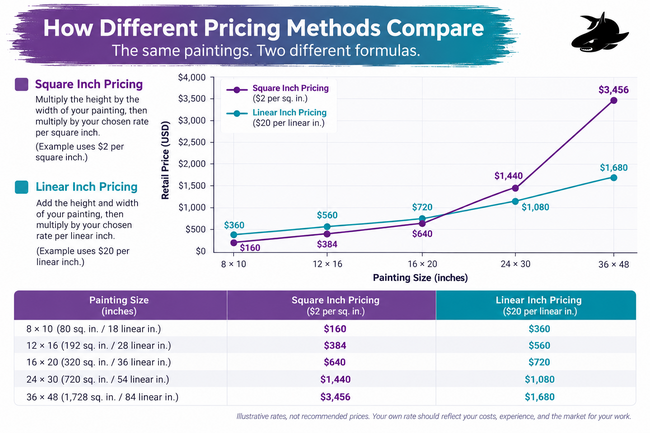
The chart above illustrates how the two formulas behave using sample rates. Keep in mind that the dollar amounts aren’t suggested prices, and the rates aren’t intended to produce matching results. Your own rate must be appropriate for your work, which is a personal decision.
How to Establish Your Pricing Rate
Before choosing a rate, start with what you already know about your artwork and its value in the marketplace. Select a painting size you frequently create and consider its appropriate retail price. That price should account for materials, labor, overhead, your experience, and what buyers are willing to pay. It should also allow you to remain profitable when selling through a gallery that receives a commission.
Suppose you’ve established that an 18″ × 24″ painting should retail for $900. Using the linear-inch method:
18 + 24 = 42 linear inches
$900 ÷ 42 = $21.43 per linear inch
You might choose a rate of $21 or $22 per linear inch.
Next, calculate prices for several other sizes you commonly paint. Do the results make sense? Are the smaller works reasonably priced? Will the prices for your largest paintings cover their production costs and provide a profit? You may need to adjust your rate before settling on a formula that works for your business.
Keep in mind that a pricing formula doesn’t determine whether your work is profitable. It provides a consistent way to calculate retail prices after you’ve established an appropriate rate.
Pricing Commissioned Paintings
Another benefit of using a standard formula is that you can quickly quote a price when someone requests a commissioned painting. Let’s say a customer wants a 24″ × 30″ painting, and your established rate is $20 per linear inch.
24 + 30 = 54 linear inches
54 × $20 = $1,080
That’s your regular retail price. However, I recommend charging approximately 20% more for commissioned work because of the additional responsibilities involved. Commissions usually require extra communication with the customer, planning, and sometimes revisions. You’re also creating artwork to meet someone else’s specifications. In this example:
$1,080 × 1.20 = $1,296 commission price
A particularly complicated commission may justify a higher premium. Before accepting the project, establish the scope of the work, payment terms, and expectations in a written agreement.
Keep Your Retail Prices Consistent
Whether you sell paintings from your studio, through your website, at an art fair, or in a gallery, your retail prices should remain consistent. A gallery typically retains a substantial commission, often 50%. That doesn’t mean you should charge less when selling directly. Your pricing needs to support your business regardless of where the sale takes place.
You may also need separate pricing rates for substantially different bodies of work, such as paintings in different mediums or series with significantly different production costs. Once you’ve established a dependable formula, create a price chart for the canvas sizes you use most often. Keep it handy in your studio, and review your rate periodically as your costs, experience, and sales history change.
Free Painting Price Worksheet
Want to put these formulas to work? Use our free printable worksheet to calculate your own pricing rate, create a price chart for your most common painting sizes, and estimate prices for commissioned artwork.

Pricing your paintings doesn’t have to be a guessing game. A consistent formula can save time, help you quote prices confidently, and give your customers a clear understanding of how your work is priced.

Speak Your Mind