by Carolyn Edlund
When you sell a piece of artwork, how much of the selling price do you actually keep? Understanding your costs reveals the answer.

Selling your artwork can be very satisfying. It’s a great feeling when a collector appreciates your work enough to make a purchase. But the amount you receive from a sale isn’t necessarily what you’ve earned. And since this can be confusing, before determining profit, you need to understand the costs involved in creating and selling that work. This article will explain that.
Many artists focus on the selling price without fully accounting for their expenses. Materials may be easy to calculate, but other costs can be overlooked. Studio expenses and the time spent producing artwork affect your earnings. And selling the work involves additional expenses, whether you work with a gallery or sell directly to collectors.
If you want to operate a profitable art business, you need to know your numbers.
What does it really cost to make your art?
Every piece of artwork has production costs, which vary depending on your medium, the materials you use, and the time required to complete the work.
Consider three basic categories:
Materials: These are the supplies used to create the artwork. Examples are canvas, paint, clay, metal, paper, or other materials. Include framing or finishing costs when applicable.
Labor: Your time has value. Determine a reasonable hourly rate for your work and multiply it by the hours spent creating the piece. Labor is a business cost, even when you’re the person doing the work.
Overhead: These are the ongoing expenses of operating your studio or business. Rent, utilities, insurance, equipment, software, and other operating costs need to be covered through your sales. You can allocate a reasonable portion of these expenses to each piece of artwork you create.
When you add all of these costs together, it will give you a clearer picture of what it takes to produce your artwork. But there’s one more element to consider: profit.
Paying yourself is not the same as earning a profit
This is an important distinction that artists sometimes overlook. Suppose you spend eight hours creating a painting, and you assign yourself an hourly rate of $30. Your labor cost is $240. That amount compensates you for your time and skill, but it isn’t business profit.
Profit is the money remaining after your business expenses, including labor, have been accounted for. Why is that important?
A profitable art business needs to generate enough revenue to cover its expenses and leave something extra. That additional income can help you replace equipment, invest in new work, build financial reserves, or cover expenses during slower sales periods. Without profit, you may be paying yourself for your time, but you will have little money left over to invest in and grow your business.
A practical example of art pricing
Let’s look at an example using our pricing formula, which starts with production costs and includes a desired profit margin.
An artist creates a painting and calculates the following expenses:
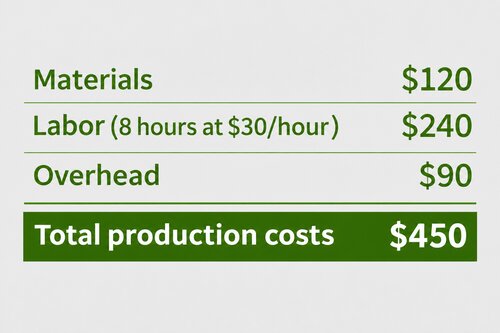
The artist has $450 in production costs, including compensation for labor. Now suppose the artist wants a 15% profit margin on the amount received for creating the artwork.
To calculate that amount, divide total production costs by 0.85.
$450 ÷ 0.85 = $529.41
Rounding to $530 gives us what we’ll call the artist’s share, which includes production costs and the desired profit. If the artwork is sold through a gallery that takes a 50% commission, the retail price would be $1,060. The gallery receives half, and the artist receives the other half.
Here’s what happens when the painting sells:

The artist receives $530, but $450 of that amount covers production costs, including $240 for labor. The remaining $80 is business profit, representing approximately 15% of the artist’s share.
This is a simplified example. Gallery commissions vary, and the actual result depends on the artist’s expenses and selling arrangements.
What happens when you sell directly?
Many artists sell their work directly to the public. This could be through their own websites, at art fairs, during studio visits, or through other collector relationships. And you receive the full retail price rather than sharing it with a gallery. But you also take responsibility for the work and expenses involved in making the sale.
These costs of sale can include art fair booth fees, travel, advertising, payment processing fees, and the value of your time spent staffing a booth or other selling venue.
Consider our painting with a retail price of $1,060. If you sell it directly, you receive the full amount. After subtracting the $450 in production costs, you have $610 remaining. However, that $610 isn’t necessarily all profit. It must also cover your own selling expenses and compensate you for the time and effort involved in finding buyers and making sales.
A gallery earns its commission by providing space, marketing, customer relationships, and sales services. When you sell directly, you step into the shoes of the gallery by performing those functions yourself, and likewise, you also bear the cost.
This is one reason it’s important to maintain consistent retail prices whether you sell through a gallery or directly to collectors. Reducing your price simply because you aren’t paying a gallery commission is an uninformed choice. It leaves you without enough income to cover your own selling expenses.
What happens when the market won’t support the price?
Our pricing formula provides a useful starting point. However, it doesn’t automatically determine what collectors are willing to pay. An artist might calculate that a painting should sell for $1,060, but then discover that comparable work typically sells for less in their market.
That presents a business decision. The artist may need to reconsider the selling price, examine production costs, or determine whether the work is financially practical to produce for that market. Sometimes a lower profit margin is acceptable. An artist may choose to sell a particular piece for less because of special circumstances or a specific business objective.
However, these should be informed decisions. When you consistently sell work without adequate compensation for labor or sufficient profit, that lack can make it difficult to sustain your art business.
Use your numbers to make better decisions
You don’t need a complicated accounting system to begin evaluating profitability in your art business. Get started by tracking the costs associated with creating your artwork and the income you receive from each sale. Include your labor, even if you aren’t currently paying yourself a formal wage. Keep track of selling expenses separately so you can see how much it costs to reach customers and make sales.
Over time, you will notice that some types of artwork may be more profitable than others. Certain sizes, formats, or production methods may offer better returns. Some selling venues may produce more income after expenses than others, and keeping track of this makes a difference in your bottom line.
You may come to the conclusion that your prices need to change. Rising material costs, increased studio expenses, and other costs can gradually reduce your profit if your prices remain the same. Knowing your numbers gives you a factual basis for making these decisions.
Calculate your own art pricing
Understanding your costs gives you a starting point for setting prices that support your art business. Our free Art Pricing Calculation Worksheet walks you through this method. You can enter your materials, labor, and overhead, choose a desired profit margin, and calculate the amount you need to receive for your artwork.
The worksheet also helps you determine a suggested retail price when selling through a gallery that takes a 50% commission. It includes a completed example to make the calculations easier to follow. Use it to evaluate your current prices or establish pricing for new work. Then revisit your calculations periodically as your expenses and selling arrangements change.
Download Our Art Pricing Calculation Sheet



Speak Your Mind