By Carolyn Edlund
Many artists think that having their images on cards would be a great way to sell their art – and they’re right! What they don’t know are basic essentials of starting a greeting card line that will make or break them in the business.
.
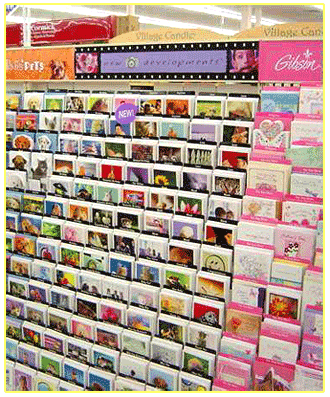
As a former road warrior and sales rep who sold numerous card and paper lines to retailers for years, I will let you in on some of the secrets:
Forget about selling a line of blank cards.
There are far too many lines of blank cards out there, and store buyers usually won’t even consider them. The reason is that 90% of cards sold are greeted. If you can’t write, get help. A compelling image will grab attention – you need a great message in the card as well to make the sale. A professional writer can make all the difference to your sales. Go to a card shop and browse to see some great examples of witty, touching and wonderful writing.
Greeted card lines must be in the proper proportions.
What’s the most popular? Birthday card sales are 50% of the market. Friendship cards account for approximately 10%, and Blank cards are about another 10%. The next most popular categories are Anniversary, Thank You, Sympathy, Congratulations, Wedding, New Baby and Get Well. Some categories are a waste of time – I will address those in another article.
Start with “Everyday Cards”.
What does this mean? Everyday Cards are titles in the categories above. “Seasonal Cards” are cards for Valentine’s Day, Easter, Mother’s Day, Father’s Day, Halloween, Thanksgiving and Christmas. You must have a big enough selection of Seasonal to present them, and they only sell for a small period of time each year. So start smart with Everyday, and once you are really established, add Seasonal cards if it makes sense financially.
The 80/20 rule applies.
This rule means that 20% of your card titles will create 80% of your sales. And 20% of your wholesale store buyers will give you 80% of your total business. Why is this important? For one thing . . .
Start small and find out what sells.
When you create your line, a lot of your titles will be duds, and some of them will be really good sellers. Don’t print a lot of all your titles and get stuck with the poor sellers! Lots of production artists go to trade shows with only a set of samples and find out what sells – good sellers get produced, and poor sellers get discontinued. Card lines can be originally printed in small quantities, and sold in a similar way.
Cards are usually sold wholesale in packs of six.
They must have matching envelopes, normally white ones, and banded with paper or plastic bands. Use good stock, and use a professional printer. Not your computer printer. The retail price of the card is always printed on the back.
This article continues with What You Didn’t Know About Starting a Greeting Card Line (Part 2)
.
Author Carolyn Edlund is the founder of Artsy Shark and a business consultant for greeting card entrepreneurs. Need assistance to improve or grow sales of your own line? Find out more here.



Absolutely one of the most helpful marketing ideas I have read.Thanks
Incredible morsels of actionable advice! Thanks for this.
This is an excellent article. I’m going to post it on my greeting card blog for professionals in the industry.
Thanks for the comments! I have interviews with at least three more professionals in the greeting card industry coming up in the next month. Stop back for more valuable information!
This is a nice resource and a good article. As an Envelope Converter and Supplier (www.apecenvelopes.com) we have actually found that for an extra penny an envelope, people are choosing colors instead of white for the envelope. Its an inexpensive method of value-adding should you wish to sell a mid-range to upper range price point.
Justin – I like colored envelopes myself, particularly if they are well coordinated in designer colors with the cards. However, I have seen companies take colored envelopes out of a line – because when viewed as a whole line on a display rack, they caused a “jumbled” look and were less pleasing visually – so it was a merchandising consideration. Good quality white envelopes, especially with an embossed logo of the line on the flap, are always nice.
In case I miss it, Keep me posted on any of your greeting card postings and I will refer to them on my blog like I did today. http://kateharperblog.blogspot.com/2010/01/bookmark-this-what-you-didnt-know-about.html
I have about 16,000 readers a month and it is a kind of clearinghouse for greeting card design info. I normally also cross post on twitter and linkedin if the article is especially relevant to the card industry.
This is a fabulous resource. I am grateful for your generous information. I am in the process of doing a card line and this info is invaluable! Thank you!
Linda, thanks for your comment. There are a number of excellent blogs for people with card lines, one example is Kate Harper’s blog (check my blogroll for link). You might also join some greeting card groups on LinkedIn for more info.
Hi! I just discovered Kate’s blog, in fact, I featured one of her cards on my blog this week! Check it out if you like.
Thanks so much for sharing info with the rest of us. So many ways to connect people and information. Have a great day!
Thank you for the helpful article. You caution against printing on one’s own computer printer… aren’t there home office printers out there one can purchase that will do a great job? I’m asking because I really want to keep everything “in house” at this point…Waiting for your answer! Thank you.
Claire,
Thanks for your comment. The reason I would advise against using home printers is that the cost of the ink would most probably be prohibitive, considering that you would have to set your wholesale prices at half of retail. Although people do make handmade cards and sell them, if you want to produce a printed card, you should find that using a printer will be a lot cheaper in the long run. They also have folding machines, and can bundle your packs of cards for you. Please let me know if you have found your home printer to be economical considering the ink costs.
Carolyn,
I was introduced to this site today and I wish I had come to find it sooner. I am finishing up the last few details on a line of greeting cards and this article has given me a few things to think about. I had done quite a bit of research on the greeting card business prior to starting the designs. I am grateful for this further insight. I think I will be making a few adjustments to the greetings.
Thank you, Heather. Glad to know I can be of some help. You might want to check out today’s article as well, which gives more tips on tweeking your line to make it more saleable http://bit.ly/qJm8d9
Thanks so much for this series of blogs they are very helpful and I look forward to reading more of your articles! I am looking into having some of my images made into greeting cards and am not sure how to go about finding a good commercial printer. Is it best to find someone local – or are their good options online?
Thanks in advance!!
Pauline, I would suggest you start by working with a local printer. You will need to meet with them, understand what they do, and get some of your card designs printed. Sometimes larger alternative card companies have their product made overseas, but that involves long runs and a longer turnaround.
i read your blogs!!!
it helped me a lot.
I am new at this business of making greeting cards
i make greeting cards of my own
and i have my own shop
but the problem is that i am 20 yr old student doing BBA and i don’t get much time to sit at my shop due to my classes.
and i found that selling printed cards can be better then handmade cards.
Q1*) I want to know that from where i can get designs for making printed cards?
Q2*) apart form greeting cards what related items i can sell in my store?
Lovely article! I was wondering – when you say birthday cards are 50% of the market, friendship 10%, and blank 10%, where is that data coming from? Thanks so much! I’d also love to know which categories, other than holiday in some cases, you consider “a waste of time.”
Jill, That information comes from my experience as a greeting card rep, and the training that our company provided, as well as my own electronically-taken inventories that kept track of hundreds of stores, what was sold and what was reordered. So those numbers are derived over time from reliable sources.
The categories that I would not recommend, for the most part, are New Home, I’m Sorry, Retirement (unless it is absolutely perfect for your line), Pet Sympathy, and any card that is for a specific relative (Happy Birthday to my Sister, for example). The point is that although some of those cards will sell at times, you need to have as many possible “turns” as you can with any store customer. Slow categories tend to sit, and can drag reorder time or even be a candidate for exchange.
This is great information, thank you for sharing!
nice work
what an amazing article. I have a small hobby business and struggled to sell on a shelf space in local crafters shop. Craft fairs can be a hit or miss and most times i dont even cover my table costs. I keep going as I have so much craft stock in my craftroom and it is also a means of therapy for my mental health and wellbeing. I am now preparing to rent a space in another shop for an affordable amount a month. i have a Facebook page where I get regular orders and still trying to set up a website.