By Carolyn Edlund
More insider perspective on starting a greeting card line, this time on Marketing and Sales.
How should you price your cards?
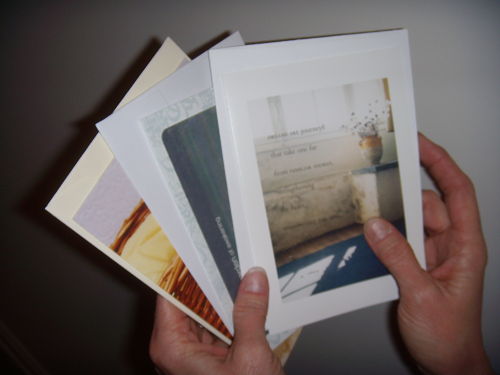
This depends on your costs, and the profit you desire. The average card on the market runs about $2.50 retail. You will be paid the wholesale price (1/2 of retail) so a pack of six cards would sell for $7.50. Cards with special details, such as glitter, rhinestones, special folds, etc. sell for more. Quite often these specialty cards are wrapped in cellophane to protect them. Meri Meri has a beautiful line which is expensive but sells well. Don’t underprice your cards hoping for better sales – it won’t work in the long run, and you devalue your work and cut your profits.
What about minimums?
That’s up to you. Remember, you are not “consigning” your cards – they are sold outright and you get a check or credit card number from the store buyer. If you want to set a minimum of $100, that’s fine. You want to have a good enough assortment of your cards in the store. However, I have seen companies use a “no minimum” policy – and if the buyer wants it, they almost always write a good sized order anyway.
What about returns?
The reality of the card business is that you must accept returns to make more sales. A 10% return allowance is very fair. This means you will allow the return in exchange for different (and better selling) merchandise within a repeat order, not a refund.
Should you have sales reps selling your line?
My opinion on this is Yes! Most importantly, hire really good reps. I’ve been on both sides (as a production artist and as a rep myself), and can tell you that a bad rep is useless and a good rep is a goldmine. Why? Reps have established relationships with their wholesale accounts, can really showcase your line, get your product great placement in a store, and bring you long-term profitable accounts. Most busy, successful store owners will rarely see a lone artist who walks in to sell them one card line. But they know and trust their regular reps whose multiple lines they buy. Savvy reps have heavy influence on buyers and can get you business you could never get for yourself.
Where do you find a sales rep?
Get familiar with trade journals like Giftware News. You could list an ad for a rep at Great Rep or visit a trade show like the Stationery Show, advertise for a rep on your website or speak with other vendors in your market. Reps often work in groups, and sell complimentary lines.
Treat your reps well.
Sales reps work on straight commission. Standard commission on card lines is 20%. That might sound like a lot, but they have lots of expenses, and a successful rep is well worth the money. Plus, by using reps you can sell all over the country, and that’s a lot of potential business!
What about niche markets?
You might have a line that appeals to a certain group. One example is Sandi Timberlake’s card line called A Little to the Left which is designed for a gay audience. We talked about her marketing, and I suggested that she partner with other vendors who are selling wholesale to stores that cater to the gay community. You may share a rep who calls on this niche market and can cross-sell many lines into a store looking for a certain type of merchandise.
Should you exhibit at a trade show?
They can be very pricey, and to justify exhibiting at a show you need an extensive product line (or partner up with someone selling a complimentary line to your target market). Trade show attendance has fallen off in recent years. A website would showcase your card line less expensively while being accessible 24/7. If you can afford to do trade shows, you can meet tons of prospects and buyers for huge accounts and chains stores too.
Why shouldn’t you just use CafePress or Zazzle to print your cards?
These online “Print on Demand” vendors have an ingenious business model, and they create printed merchandise one-at-a-time. If as an artist you prefer to focus on your studio work and offer your designs on cards, mugs or t-shirts as a sideline, you may want to use them. However, if you want to get into the greeting card business, and pursue it full time, it is much more cost-effective to use a commercial printer. You will find that the cost to you for each card and envelope will be literally pennies whereas Zazzle, for example, charges artists $1.49 per card. Although they have a place in the market, they would be a very expensive middle man.
What other alternatives are there?
You could sell your art to a greeting card company, via a licensing agreement. The card company will take care of writing the greetings, production, marketing, and sales of the merchandise. I have an interview coming up with some of these buyers, so check back on this site to get details on what they buy, and the type of art they are seeking.
This is the third in a three-part series about starting a greeting card line. Previous articles are:
What You Didn’t Know About Starting a Greeting Card Line (Part 1)
What You Didn’t Know About Starting a Greeting Card Line (Part 2)
Author Carolyn Edlund is the founder of Artsy Shark and a business consultant for greeting card entrepreneurs. Need assistance to improve or grow sales of your own line? Find out more here.

Thanks so much for sharing this information. I found it very helpful!
Thanks Chuck – I have lots more information and some really interesting interviews, so stay tuned!
Thank you so much for this information. With so much to thnk about it’s nice to have someone in the know telling you the way it is, and what not to do, becuase you have experience and because you have been on both sides of the fence. I will be be following your blog more often.
Article 1, 2 & 3 were packed full with good info. Any chance this is available in one PDF for my own future reference. I’d like to share with my husband and business manager. Thank you.
Natalie,
The three part article is assembled into one on Squidoo – search for Artsy Shark there, it is my only post so far. Due to their space constrictions, I did condense it somewhat, but I think all the pertinent information is still included. Let me know if you found it!
This has been terrific information for me. I am completely new to commercially offering my cards for sale. Question for you about the trade shows (specifically the NY Stationary Show), is it acceptable/appropriate to bring some card samples to show to propects, especially if the cost of a booth isn’t practicle at the moment?
Nancy, I would encourage you to go to the Stationery Show, to walk the show, get more information and see if you would like to exhibit in the future. It is not appropriate to take your own samples, and solicit business if you are not an exhibitor – in fact, it could get you escorted to the door if reported. I would suggest this – if you meet reps in booths, and find out about their multiple lines, take their business card, and follow up with them after the show if you would like them to consider repping you. And talk to exhibitors who are not busy, and if they are willing, about how they do business and whether they think the show is valuable. Never interrupt an exhibitor with buyers in the booth. If a buyer walks in while you are speaking, step aside and leave the booth. Going to a trade show before you exhibit is a valuable experience, and I’m sure the promoters would be happy to let you attend.
Does anyone else have suggestions about visiting trade shows before you exhibit?
Question on the selection of a printer – do you simply find a printer with the capabilities to do what you want at a reasonable (competitive) price, or are there certain types of printers that are best for greeting card production? I’ve always wondered about that. I also have questions about the quality of printing, and how one evaluates what’s possible in that area. Perhaps there’s an information resource you can point me to if these questions are too cumbersome to go into here. Thanks so much.
Thank-you for sharing all your information and knowledge about this industry! Very helpful info. Upfront and honest I love it! I am hoping to get my greeting card company expanding to a distributor or sales reps asap. I have been doing the research, marketing, website, designing and selling myself for 3 years. Now with 3 kids, it is time to pass off the sales side, but I have found it difficult to find reps/distributors. I am keen to read more of your posts and learn more of your tips and tricks…
thanks again,
AM
How do card designers make that transition, from creating a $4.00 card, and selling it directly to the consumer for $4.00, and selling it wholesale for $2.00? It would seem you’d have to have located some major volume sales opportunities to justify cutting your profits in half. Is that what people do, accumulate customers until they get to the point that selling wholesale doesn’t seem counterproducive??
I Agree with everything Admin says below but would like to add this. A few years ago I was selling my hand trimmed art cards for $5 each or 3/$10 direct to consumer at farmers markets in the summer. I also went around to all the inns and gift shops in my area and was wholesaling the cards for $2.00-2.50 each depending on quantity purchased from me. I look at it this way: selling direct is one income stream, wholesaling is another income stream, the original art is another income stream, giclees are yet another income stream. As a professional fine artist looking to support myself via only my art having several streams of income can create a larger river of income. The cards served to “advertise” my website to potential buyers of paintings, too. I never begrudge a gallery for making money on their commissions selling my art. Why not? Because once again it is an INCOME STREAM. Good luck!
Good call, Katy. I especially like cards as promotional “ambassadors” for your fine art. See my article here for some ideas on how to use them https://www.artsyshark.com/2013/04/01/art-notecards/
Nancy, that’s a great question, and one that anyone new to wholesaling might ask. Pricing for wholesale comes from “the ground up” rather than “top down” as you indicate. If you have a product that you need to sell for $4.00 to make reasonable profit, then you cannot simply cut the price to $2.00. Instead, you might ask “What product can I make in multiples for $2.00/ea wholesale which will net me enough profit given all costs?”, then double that for retail. Consider your card production costs. Are you having these printed in high enough quantities, and is your printer reasonable? Does it make sense to you to sell one at a time, or would you rather sell 100 cards at once for a discounted price? There are many variables. I would never suggest that you just cut prices in half. However, given the effort to sell individual cards at retail, you may be able to cut your work time significantly by selling in quantity.
Carolyn, this is such a great series of articles. I’ve learned so much from you. May I ask you to expand on this part:
A 10% return allowance is very fair. This means you will allow the return in exchange for different (and better selling) merchandise within a repeat order, not a refund.
I’m not seeing the connection between the 10% and the exchange. It may be that I don’t completely understand this because I’m not yet up and running as a card seller, but rather am still getting started. I’m trying to start off on the right foot and it makes sense to have in mind a policy before this situation should arise. Anyway, any clarity you can add would be terrific. Thanks!
Hi Amy, What I believe you are referring to is a 10% return allowance. The customer would trade back slow sellers equal to 10% of the value of the new order. Frankly, many times as a rep I would simply destroy the slow sellers. They may be shopworn, possibly discontinued, or not worth the shipping cost to return.
If you decided to save on shipping costs, but desired proof of destruction of the slow sellers, why not ask the retailer to cut off and return the bar code or item number off the back of the cards they were destroying? These could be put into an envelope with one stamp.
Sometimes artists resist the idea of a return allowance. But I have found that what happens is the customer ends up staring at all the slow sellers which are left over and cannot go back, and they find it easy to forget about everything that has sold. Better to save the account with a return.
Thank you SO much for the clarification and advice! May I ask one more question? Your answer brought to mind another thing I have been wondering. If you have a very small card business that is just getting started, do you need to have bar codes? (And if so, where can I find out how to do that?) And is there any rule of thumb on creating item numbers? For example, it seems like if you started with #1, it would all too obvious that you are just getting started. Should it be a combination of letters and numbers, or how do people typically do this? Do small shops expect UPC codes? Just a retail price? The closer I get to this reality, the more questions I realize I have!
Thanks again!
I have a question on how much to discount your wholesale for people who would buy in bulk, I see individual cards, small packages and larger packages and customer wants to know many price breaks and such but just do not know where to start. I was thinking a percentage off when they reach a certain monitory values. Please help, thanks!
Hi,
I am planning to start an online greeting card business which involves customising the card online and send a print copy of greeting card. What should i do to get greeting card designes(template for different occasions/fetivals), i may need close to 200 designs, so that our customers can go online and select according to their choice.
I searched online but could not get much options, could you please assist.
Roger, Why not contact an art licensing agency and review the work of their artists to find someone you can license designs from.
This information is so great. I am learning so much. Between the articles and the questions people have asked, I have learned a lot. Especially the information on Cafe Press. I used them for this past year. I am working on fully developing my line of cards that I can sell to stores. In on of your article you suggest having at least 48 cards to begin with. Can the 48 consist of different lines? For eg: I am working on 3 lines ( one featuring quotes, one with a character and one that features purses) Can the 48 be a combination of these three or does it have to be 48 of one designed line?
Anika, thanks for your comment and your question. The 48 designs should be cohesive as one line, so that they work together beautifully on a single display.
I am wondering how other small greeting card business owners deal with this one: I started by wrapping each card in a cello wrap. However, after getting a good sized order from a store, I realized that it is extremely labor intensive and time consuming to carefully stuff each cello bag with a card, envelope and correct insert (containing the inside sentiment) and now I’m re-thinking the whole thing.
Is it reasonable to charge extra if the shop keeper wants the cards wrapped? Perhaps $.10/card?
What is your opinion on the wrapping in general? (I’ve been told by some people that they don’t even look at those cards because they assume they will be too expensive.)
Amy, I completely agree with the people who don’t look at cellophane-wrapped cards because they scream “expensive”. If your cards have attachments like glitter, feathers, or anything else that needs cello protection, go ahead and use the sleeves. If not, why are you using them? I once repped for a company that wrapped plain paper cards to give an upscale look. When they decided to stop using the sleeves, sales jumped! Lesson learned.
My suggestion is to just stop with this unnecessary wrap. It saves time and money and is more eco-friendly. And I haven’t met a store owner yet that would take a look at a paper card and ask where the wrap is.
You articulated what my gut has been telling me!
To answer the question, “why are you using them?” my thinking was to protect them from getting tattered from handling, and also to keep them flat. I use a high quality “organic” stock that is difficult to fold and keep flat until it has been pressed for awhile. They tend to slightly open when they are first made. However, I don’t want them to scream “expensive”, as you so accurately put it.
Lesson learned! Thank you so much.
Amy, your cards should stay flat when they are displayed in packs of six in regular fixture pockets in the store. You are shipping them this way, aren’t you?
Good point. Well, I’m not requiring for stores to order in sets of 6, although I have heard that is recommended (or at least a minimum of 4). I wanted to give stores the flexibility to order as many as they want of any design. Trying to be super flexible right now, so as not to lose any potential customers.
Bad idea?
Yes, Amy – bad idea. Store buyers are trained (by reps) how to order cards, and this is the way it’s done. Six is standard. You are missing sales.
Message received.
Thank you very much!
I am so excited that I found this blog. I have read all the entries and they have been very helpful. I have a ton of questions as I too am starting a card line. Printing is my largest challenge right now. I am still doing research on where to print and what paper stock to use. If you have any suggestions, I would love the advice.
Hi I have a great idea for a new card … but where do I start… im from canada .. do i need to patent it ? or maybe sell the idea to a card company ? is that possible
Hi Carolyn,
Thanks for all the helpful info. You mention that the average retail price for a card is $2.50. But from looking at the time stamp of the comments, I’m guessing that was written in 2010 or before. Would you still say that price is true? From looking at cards nowadays, 2015, I’m guessing it’s higher. The last card I bought for my wife was $7.00. And it seems many are around $5.00 and up.
Thanks in advance,
Paul
Hi Paul, yes that article was written a few years ago. Prices really vary, depending on whether you are buying a simple printed card or something quite elaborate with music or that is handmade. The average price I quoted was for a typical printed paper card. I believe that price point now to be about $3.50. See if you agree.
Hi Carolyn,
I’ve been developing a card line for a little while now and would like to start by selling just a few of the designs on etsy this December. I’m having a really tough time locating printers though. Plenty are around, but the cost is usually well over $1 per card to print, and you usually have to order each design separately. You mentioned printing yourself can cost pennies per card & envelope. Am I missing something? Do you or anyone here know of good online printers that are cheaper and have lots of card paper selections? Any advice would help : )
Lucie, Quite often the artists I know who are selling their cards actually do work with local printers in their area. I have no idea about your line or your prices. CatPrint.com is an online printer with a good reputation. Perhaps other people in the industry could steer you towards some resources. Or you could get in touch with the Greeting Card Association https://www.greetingcard.org/ for some ideas.
Hi,
I have a one time project to take a series of 15 pieces of original art work and make card sets for a non profit fund raiser. I can’t afford to print them up front so they will advertise on line up until the event in July. I will donate a percentage of proceeds for the organization depending on the cost and interest so it will help them raise awareness for battered women and children. Can you direct me to a printer her will make sets of cards and quality postcards or prints to sell? thanks.
Devi, Your best bet will be to find a local printer. I would not have recommendations for printers all over the country. Start checking into some possibilities in your town, and ask to see their existing work, then discuss your project with the business owners.
If I must say that I had good experience with PrintingSolo.com. Otherwise zazzle is also okay but they had higher prices when compared to PrintingSolo so I just order from them to avoid any hassle.
Do you have any resources on copyright laws or typography limitations for an individual looking to create a greeting card line?
Can you answer this questions for the Greeting Card Business?
UPC (bar codes) buy GS1 or SingleUPC?
To sell wholesale to retailers (though Reps) and maybe Amazon?
If you purchase a single barcode at price point level, inventory cannot be determined through scans of sold product. If a store customer uses EDI (automatic reordering) this wouldn’t work. Buying barcodes at title level for cards makes for more accuracy, but it will cost more.
YES, I did my research – 2017, found GS1 to buy authentic barcodes 1-10 at $250.00 renewal at $50.00 yearly and/or the really expensive $750.00 for 100 bar codes renewal at $150.00 ($7.00 for each barcode label?) – WOW really expensive for a small new Card business. OMG, I looked at GS1 website US vs UK and the prices are so much cheaper at the UK GS1 ? Really? Why? because the US GS1 is about GREED and MONEY! so buy the GS1 1-10 and use the UPC per price point. A price point is a fancy way of saying the retail price of an item. So if your cards have price points $2.00 and $4.00 you would have two UPCs, even if you have 500 styles at each price. OMG – read the book “Pushing the Envelopes”. The US is XXXX the small businesses! Check out here is a link below that helps, I think, to clarify why you would go direct or through a reseller. It is a combination of costs and of the number of product that you want to have bar codes .
https://guides.wsj.com/small-business/starting-a-business/how-to-get-upc-codes-for-your-products-2/
You will be paying for the use of that company’s reseller ‘s identification number — not your own ID. That means your products’ UPC will begin with another company’s ID number. It can be a fine solution if you are cash-strapped or working with small or independent retailers — if the retailers don’t mind — and just selling one or two products. But it won’t work if you’re planning to sell through major retailers because they generally require product makers to have their own ID identification numbers. So use the GS1 and SKU# with your own in house inventory system. Bar Codes were way to complicated!!!!, but I figure it out – LOL at US GS1!
Thank you soooo much for all the insight and inside info! I have been sitting on a greeting card dream since Operation Desert Shield/Storm (I know…I know…, but “life” kept happening). The dream is off the shelf now and I’m going for it. Do you do personal/professional mentoring? I would love to hire you!
Thanks, Jen. And, yes I do quite a bit of business consulting and mentoring for greeting card entrepreneurs. You can learn more about that here https://www.artsyshark.com/build-your-art-business/