A Site for Emerging Artists
Greeting cards
Top 10 Articles on Artsy Shark for 2011
Dec 21st
By Carolyn Edlund
This year’s countdown of the ten most read and shared articles on Artsy Shark.
10. Making Art and Making a Living - Do you have to support yourself through your art to be an “artist?” Or does the financial pressure hurt your creative growth and your sanity?
9. “You’ll Never Make a Living as an Artist” - Are you surrounding yourself with supporters, or naysayers? Who is holding you back? Your family, your friends? Or is it you?
8. Matching Artists with Corporate Buyers - Joyce Creighton’s fascinating story of how she is connecting artists whose work is appropriate for corporate settings with clients looking for their work.
7. How to Make Your Customers Fall in Love with You - Want more business and repeat customers? That’s right – spread the love.
6. Do You Want to be a Childrens Book Illustrator? - Cherish Flieder discusses the steps in childrens book illustration, and how to get started in the business.
5. Creative Marketing for Artists - Think outside the box when it comes to promoting your work. Here’s some examples of how other artists did it.
4. 6 Ways to Improve Your Greeting Card Sales - Is your line balanced? Is it big enough? How often should you update? The basics on what you must do to have a successful greeting card business.
3. What’s Wrong with Your Art Website? – Artsy Shark asked the experts for their pet peeves when visiting art websites. Are you guilty of any of these sins?
2. A Guide to Pricing Your Artwork – Professor, TED speaker and entrepreneur Karen Atkinson gives great advice for artists on this perplexing but essential topic.
1. Are Your Prices Unrealistic? – Are your prices too high? Too low? How your competition affects your perspective. Lots of comments and opinions about pricing.
Consultation Case Study: Improving a Greeting Card Line to Increase Sales
Sep 7th
By Carolyn Edlund
Is This Greeting Card Line Ready for Retail?
In a recent consultation appointment, I worked with an artist who designed a line of greeting cards, and has a wholesale catalog in process. She was looking for help in evaluating her line as a whole, and wanted specific advice about making necessary changes, so that her products would be as saleable as possible.
We discussed sentiment categories, sizes, pricing, stock and envelope choices, cellophane, barcodes, terms, minimums, headers, display options, trade shows, related products, and marketing strategy.
Evaluating Categories
One of the most important factors in determining the success of a card line is balance. When a card artist schedules a consultation, we always start by evaluating the percentages of their line that fall into different categories, to be sure they are properly balanced for the marketplace.
We took a look at the percentage of her line greeted as Birthday, and decided to increase it by changing the greetings on some non-Birthday cards. If Birthday is not a full 50% of the line, it does not reflect market demand. Then we reviewed other categories, such as Friendship, Anniversary, Thank You, Sympathy, New Baby, etc. If these sentiment categories are not in the right percentages, sales suffer there as well.
Blank Cards
I found that this artist had too many blank cards in her line, and was unsure of which ones to keep. We discussed how to choose the cards in her line that would work best as blanks.
Many artists produce blank cards only, which is a pet peeve of mine. If you are willing to turn away 90% of American buyers (who are looking for cards greeted on the inside), then go ahead and produce your blank line. Store buyers have little interest in looking at “yet another line of blanks,” no matter how pretty or appealing.
Consumer demand determines what sells, and you need to supply what they want in order to be successful. I give a pass on the issue of blank cards to artists primarily creating paintings or drawings who just want to sell packaged boxes of blank notecards as a sideline. End of rant.
Fine Tuning the Line
Another crucial process in getting a line into stellar shape is to review each individual card. The image on the card grabs the customer’s attention, but the message will sell it. Is the message clear and complete? Does it work? Take a look at your own line, and evaluate each one. Ask yourself, “Who would buy this card and why? Who would they send it to?” If you don’t know, make some changes.
My client’s line needed some adjusting, particularly because she had some categories which aren’t popular enough to include in a small collection. Several of them were in the “Bon Voyage” category, which accounts for about .0001% of card sales in my estimation. We worked together to change the greetings and put them in more popular categories rather than let them languish as unsold inventory.
What to Toss
Other categories generally not worth including (unless you have a large line or specialty market) are New Home, Good Luck, Retirement, Bridal Shower, Baby Shower, I’m Sorry, and Pet Sympathy. Seasonal (holiday) cards of all types and cards for relatives should also not be included in small card lines. Some people may take exception to this, citing their Christmas card collection. Include that holiday if you must, but be aware that returns/exchanges and other issues may surface with your retailers.
Pricing
My client felt unsure about her pricepoint, and also whether she should be printing the retail price on her card. We adjusted the retail price for her, and I strongly suggested the price be printed on each card. I do not know of a single retailer who has the time or interest to stick prices on greeting cards.
Artists should become acquainted with average market prices for their type of product. Don’t try to reinvent the wheel on this with an unusual retail pricepoint. For example, $2.17 is not a card price. Prices typically end with .25, .49, .50, .75, .95 or .99, and the public is accustomed to this.
Goals
A card line consultation and review encompasses many topics. We address the line as a whole, and every aspect of the processed involved in selling it – making it ready for retail.
When evaluating your own card line, work towards accomplishing these two goals:
- Adjust the line to make it easier and more appealing for the customer to choose your cards over your competition
- Remove any barriers to the sales process, both at wholesale and retail
In this competitive industry, small details can make a huge difference. Does your card line measure up?
Greeting Card Entrepreneurs Take Advantage of Niche Marketing
Aug 10th
By Carolyn Edlund
Greeting card designer Swati Bhagat and marketing director Faith Featherstone make a potent team of entrepreneurs in their home town of Toronto, Canada. Although the greeting cards are fairly new, they have used strategies to create a buzz around their Artistry Card line to build a reputation and sell wholesale to retail establishments.
Billed as a “Canadian stationery company that sells socially responsible, eco-friendly, superior quality greeting cards and stationery paper goods,” they have quite a few ways of expressing that commitment.
Some of the ways Artistry Cards is walking the walk:
- Using post-consumer recycled paper to produce cards and envelopes
- Biodegradable cellophane on each card
- Orders shipped in 100% recycled cardboard boxes
- 5% of sales donated to Kiva, a micro-loan project assisting entrepreneurs in developing countries
- Recycle symbol incorporated into all designs in their Being Green line
What’s been accomplished? Noticed for her great designs and eco-conscious approach, Swati landed a front page interview in the Entrepreneur section of Canada’s National Post. A large Canadian retailer has expressed interest, and is working on orders with Artistry. They plan to bundle cards together with twine for a more natural look, and market them with men’s products.
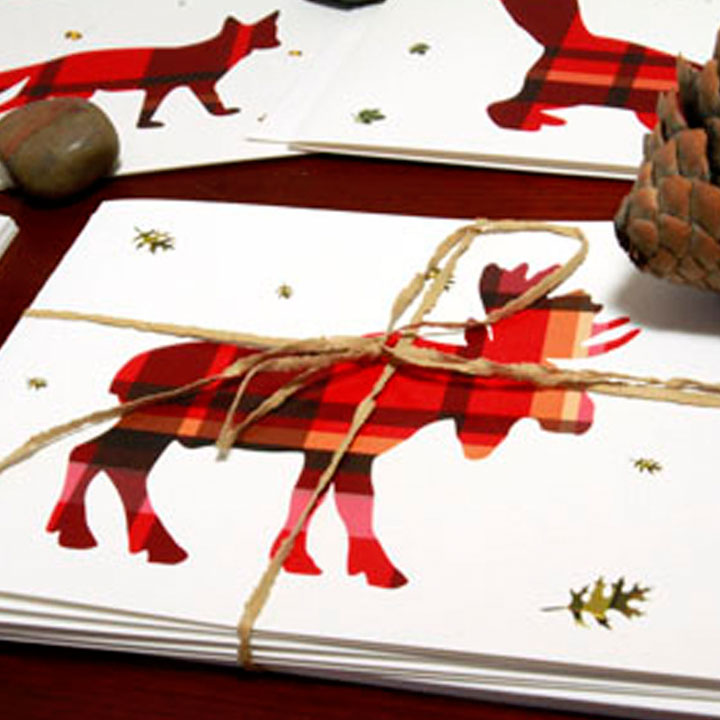
Faith notes, “Artistry Cards is all about nature, from the paper we print to the ideas.” Their line incorporates Canadian themed cards such as wildlife charmingly depicted in plaid silhouettes, Woodland Creatures (in woodgrain, of course) and Flora and Fauna notebook sets.
Staying on topic in their chosen niche creates a tight, focused body of work which has become a signature look for the company. This focus, and their earth-friendly message, makes it easy to market their concept to like-minded vendors who embrace the popularity of recycled, reused and waste-free products.
Marketing is a top priority for the team, with Faith spending a lot of time producing press releases, approaching publications and blogs for publicity, and using social media. Her message promotes the line as a “guilt-free alternative to conventional paper products.” She cross-promotes their wholesale clients by mentioning them in articles about the card line.
Having their own storefront has been a great way to test-market new products and control the printing process to get perfect colors and assure a quality product. This also helps drive local press exposure. Artistry Cards is owned by Pixel Print, which Swati established in 2006. The store is located at 1319 Dundas Street West in Toronto.
Alaskan Artist Finds Success in Niche Market
Jul 21st
By Carolyn Edlund
How one artist has used regional images and themes to market her line.
Jill Marshall came to Alaska in 1975 for a three-month stay, and hasn’t looked back since. She started a graphic design firm called Marshall Arts Design, which has evolved into a business where she uses her skills in graphic design and painting to create greeting cards which have become extremely popular.
Jill blends her love of her adopted home state with the wildness of Alaska’s people and place, weaving these themes into a strong niche line which has resulted in sales of over 30,000 cards in over 75 gift shop locations. “We have a large visitor industry here in Alaska,” she says, “So I aim my card art to that audience.” Jill wholesales her cards directly to the gift shops. “We have a wholesale gift show in Anchorage which makes it easy to access shops in remote locations. Some of the shops are reachable only by air or sea. It would be difficult and costly to visit them all individually.” She also sells her card on her website.
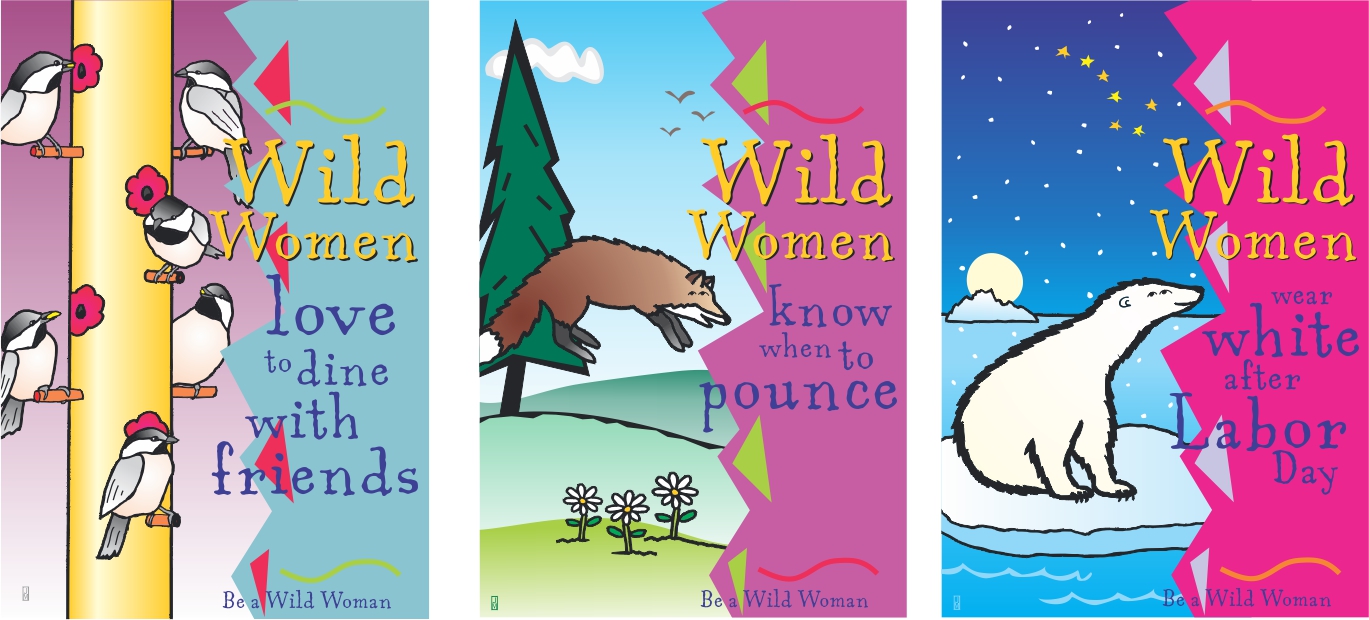
Marshall Arts Designs started with traditional watercolor featuring natural elements of birds, berries, animals, flowers and Christmas themes. Moving into a more whimsical style led to the Wild Women series, which combines drawing and computer graphics. Jill recently has expanded into the licensing market, meeting manufacturers at the Surtex show in New York. She continues to explore and grow as an artist, and states that she believes in the old saying “The best way to predict your future is to create it.”
AS: Which of your design collections are more popular – traditional or “wild”? Are you marketing them differently?
JM: They are both about equally popular. Of the traditional ones, the Flowers of Alaska series sells more than the Berries, Animals and Birds series. There are five paintings in each series. Each gift shop has different ideas of what sells best for them. Both visitors and residents purchase the cards and posters. The Wild Women series (there are 20 of them) has sold very well too. The two styles are so different that gift shops have no problem carrying both, which are sold as individual cards and boxed. I market each collection the same way. They are aimed at women (since they do the majority of card purchasing) both visitor and resident.
AS: What niche markets have been successful for you? Are you selling to
stores in the lower 48 states?
JM: I guess you could call Alaska a niche market! I have not expanded to stores in the lower 48 at this point. I am working on designs that have less of an Alaskan theme to them to appeal to wider audiences. I am undecided if that’s something I want to take on myself or work through a distributor because of the logistics involved, Alaska is very far from the rest of the U.S. and travel and shipping are not inconsiderable expenses. I’m still looking at the numbers.
AS: Any future plans to expand this line or release any new collections?
JM: I’ve redesigned the Wild Women into bookmarks. I’m also looking into magnets of the designs. I’m always coming up with new ideas for the next Wild Women set. Since I release them in sets of 10, I have to wait until I’ve got that many worked up. I also keep looking for ways to repackage the existing artwork to continue to generate revenue from them. That’s one of the best parts, you keep generating revenue long after the original work is done.
AS: Any advice for beginning artists who may want to start a greeting card
line themselves?
JM: You are the artist, manufacturer, salesperson, advertiser, distributor, and accountant all in one. It’s important to give the appropriate time to each of those job titles. Not just the fun ones. I choose to do it all myself. I’m a business person (having run my graphic design firm for 23 years) and an artist so I already had those skills. I did have to learn to talk to the shop owners and sell myself and my product. I’m an introvert by nature so gaining good interpersonal skills was important.
Go out and look at the competition. There’s a lot of it! It’s important to have a look or concept that sets you apart. And to test market it as much as you can. Show it to people in the target audience and listen to their feedback. Talk to as many shop owners as you can to get their insight as to what sells and what doesn’t. And really pay attention to the business end. The numbers have to add up.
6 Ways to Improve Your Greeting Card Sales
Jan 27th
By Carolyn Edlund
Although there is no “big secret” to creating a successful greeting card line, there are some basics that are always necessary – compelling images and great writing. A catchy image will grab the attention of the shopper, and the right message will sell the card. Whether clever, heartfelt, or edgy, you can design a line that will be successful if you start it with those good “bones”.
Here are six additional considerations that can improve your line and help you avoid pitfalls which lead to slower sales:
- Know your audience. No one card line will appeal to everybody. Do you have a clear idea of who will be purchasing your line, and is it tailored to that buyer? If you are planning to focus on a college audience, for example, include lots of friendship and love cards, and more blanks than a regular mix, which will do better on campus. If your niche is the military, keep in mind that Get Well, Sympathy, Congratulations and Love/Miss You cards are big sellers to that group. Do some research first to find out if your idea for a card line will fly. If you only want to sell divorce/break up cards, for example, you are gearing your work way too narrowly, and have virtually no chance for success. Get clear on why you are creating your line and who would actually purchase your cards. Market research will help – get impartial opinions from others on whether they would consider buying your cards. Your mother’s opinion doesn’t count.
- Use the right format. Most greeting cards are approximately 5” x 7”, which is a good size to stick with, as card racks can easily
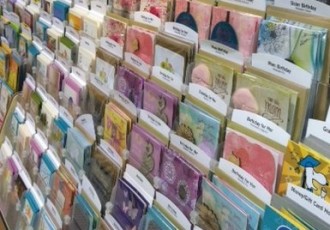
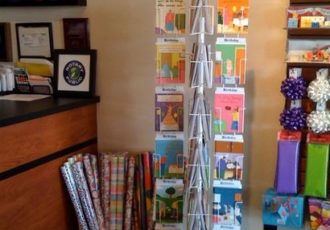
accommodate them. Cards which are designed in a “portrait” (vertical) format generally show better and sell better than cards designed in a “landscape” (horizontal) format. (This applies to “counter cards” in racks – horizontal is fine if you are selling packaged blank notes.) If you are selling to retailers, many will have “in-line” displays, such as that shown in the photo. This means that only the top few inches of the card will be showing, not the whole face. Keep this in mind when planning the layout on the front of your card to attract shopper’s attention. Your cards will be competing against many other cards, and it’s easy to get lost in the crowd if you don’t stand out. - Design a big enough line. Some artists create a few cards and want to market them before they have enough critical mass to create an effective collection. My suggestion is to have 48 titles minimum. These cards should all work together visually to give the best impression.
- Greet your cards. If you are trying to sell a collection of blank cards, you are eliminating 90% of the market, who buy greeted cards. This is a pet peeve of mine. As a former card rep, I have seen way too many retailers refuse to even consider a new line of blanks. Greeted doesn’t just mean that “Happy Birthday” is written inside – it means that your message is well-written and appealing. If you simply can’t write greetings, get some professional help. It will be worth it in the long run.
- Balance your line correctly. This is a crucial consideration, and I go into the subject further in What You Didn’t Know About Starting a Greeting Card Line – Part 1. The number one bestselling sentiment is Birthday – this is 50% of your market. If your line is small, stick with the basic categories– Birthday, Friendship, Blank, Get Well, Sympathy, Thank You, Congratulations, Baby, Wedding and Anniversary. Less popular and sub-categories such as Bridal Shower, Retirement, New Home, I’m Sorry and Good Luck probably shouldn’t be in your line at all at first unless they fit into your targeted audience (see #1). I suggest not marketing holiday cards if you can’t commit to designing a whole collection of them. In my opinion, holiday cards should not be considered until after you have a good selling line of everyday cards established. However, if you have a target audience that demands it, go ahead – for example, the college consumer is very, very big on Valentines (but Christmas cards don’t sell, because the semester ends before the holiday).
- Update regularly to grow sales. This actually applies to any line of products you may design. Your customers want to see “what’s new” and you can create excitement and drive sales by updating your line several times a year. Communicate and promote your new designs through email newsletters, brochures, or even sending some free samples to your wholesale accounts. Updating also means that you are culling slow sellers from your line. If you have some real “losers”, don’t be tempted to add them into an order from a regular customer. A first-time order from a new customer should ideally be your bestsellers in every category.
Have you found techniques that helped grow your card sales? Please leave a comment or suggestion!
Print
Digg
StumbleUpon
del.icio.us
Facebook
Twitter
Google Bookmarks
Reddit
email
FriendFeed
LinkedIn
Tumblr


Featured Artist Leah Jay